
'In the last 55 years India and Pakistan have gone to wars, but nobody spoke about scrapping the Indus Waters Treaty.'

Pakistan today pressed India to release its share of river waters under the Indus treaty as it has documentary evidence that its due share of water had been "stolen" from the Chenab river.

Jaishankar noted that it would be difficult to say what will happen in the future as there are a lot of "contradictions and frictions" out there today.
India described Pakistan's allegations of stealing water as "preposterous and completely unwarranted". Pakistan has alleged that India is stealing its share of river waters and waging a water war, saying it is "scrupulously" providing Pakistan its share of water in line with the 1960 Indus Waters Treaty.
Indian High Commissioner Sharat Sabharwal said on Saturday that reduced flow of river waters into Pakistan are not the result of any "violation of Indus Waters Treaty by India or any action on our part to divert such flows or to use more than our assigned share of water from Western Rivers".
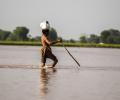
The Express Tribune reported that a post-flood report of the Irrigation and Power Department says India provided misleading information regarding water flows in Rivers Chenab and Jhelum resulted in aggravating damage in 14 districts during floods between September 5 and 17.
Pakistan's Indus Waters commissioner Jamaat Ali Shah informed the media about the roadmap and said both sides had decided to hold two additional meetings one at the end of March and another in June for "dispute resolution". Both meetings will be in addition to the mandatory one scheduled for May, he said.

Indus Water Commissioner G Ranganathan has written a letter to his Pakistani counterpart Syed Jamaat Ali Shah inviting him for discussing the issue
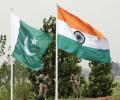
'If there is a background of some kind of mutual understanding on how the dialogue process might develop in a mutually satisfactory manner...' 'If this understanding impacts positively on the ground situation...' 'As of now this is a heroic assumption. But it does not have to remain such.'

'No prime minister of India is averse to normalise relations with Pakistan, if it is possible to do so without altering our fundamental position on Jammu and Kashmir,' notes Ambassador T P Sreenivasan.
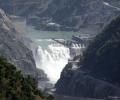
Pakistan has raised objections to four power projects being built by India on the Chenab river on the ground that they allegedly violate the Indus Waters Treaty.

Pakistan on Monday termed as "irrational" India's strong reaction to a court's ruling ordering release of 2008 Mumbai terror attack mastermind Zaki-ur-Rehman Lakhvi, but hoped that the issue will not affect the proposed bilateral talks.

An eight-member Pakistani judicial commission team crossed into India from the Wagah border check post in Punjab on Saturday to conduct the much-delayed cross-examination of witnesses in the 2008 Mumbai attacks, which claimed 166 lives.

'We need to be in a perpetual state of aggression, and able to swiftly change the goal posts to keep Pakistan in a state of imbalance,' argues Sanjeev Nayyar.

Sanjeev Nayyar suggests 16 measures by which we can tackle our unrelenting and untrustworthy neighbour.

'Absolute non-violence is not only sinful, but immoral.' 'This doctrine of non-violence benumbed the revolutionary fervor, softened the limbs and hearts of the Hindus, and stiffened the bones of enemies.' A revealing excerpt from Vikram Sampath's Savarkar (Part 2): A Contested Legacy, 1924-1966.

Pakistan on Wednesday said it was "encouraged" after BJP's Prime Ministerial candidate Narendra Modi's remarks regarding ties with foreign countries and asserted that it was looking forward to a stable government here to engage "quickly, comprehensively and meaningfully".
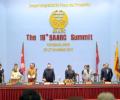
Apart from India, Bangladesh and Bhutan have also pulled out of the SAARC Summit in Islamabad in November, saying the environment is not right for the successful holding of the meet.

It was bumper-to-bumper traffic at many spots in Gurgaon.

'Our biggest problem has been keeping this country together.' 'Nation building is never easy. It is a very difficult task.' 'Even 70 years is not too long a time.'
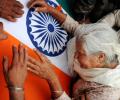
Basit was called in by Foreign Secretary S Jaishankar to convey India's strong views on the incident, the external affairs ministry said.

Indians must remember that Pakistanis hate losing to India, at war or in cricket, says Sanjeev Nayyar.

'We have never had a policy regarding Pakistani artistes working in India.' 'We welcome them with open arms and that remains the official policy of the Indian government, including the current dispensation.'
